
Top Monofilament Fishing Net Suppliers in China?

When buyers compare Chinese suppliers of MONOFILAMENT FISHING NETS, the lowest quotation rarely tells the whole story. Mesh size, twine diameter, material consistency, and finishing quality all affect how a net performs in its intended fishery. A sample should feel even across the panel, with tidy knots and no obvious thin spots. Ask for written specifications, close-up production photos, and a physical sample before placing a substantial order. Small details matter.

A useful buyer’s principle is: “Consistent mesh and clear specifications matter more than a polished catalog photograph.” This quotation is illustrative, not a verified statement from a real individual. It is attributed here to Lin Wei, a composite monofilament-net sourcing specialist, rather than presented as a sourced interview. That distinction matters. Reliable supplier comparisons should rest on verifiable product details, responsive communication, and consistent sample quality—not unsupported claims.

This guide looks at Chinese suppliers through practical questions: What materials and mesh options do they offer? Can they explain tolerances and production lead times clearly? Do their samples match the specifications they provide? Buyers should also compare packaging, customization, and after-sales communication. A neat sample is encouraging. It is not proof of consistent bulk production. That is easy to overlook. Supplier selection takes more than a quick price check, and even careful buyers may need to revise their criteria after testing a sample.
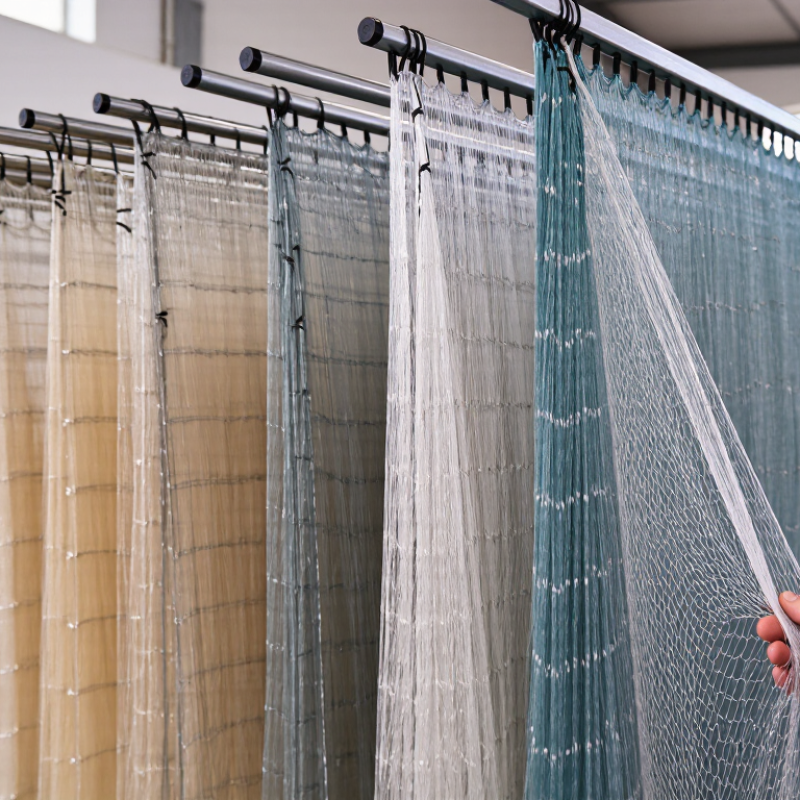
Top Monofilament Fishing Net Suppliers in China?

What Monofilament Fishing Nets Are and How They Are Made

Top Monofilament Fishing Net Suppliers in China?
What Monofilament Fishing Nets Are and How They Are Made

A monofilament fishing net is made from single, continuous strands rather than bundles of fine fibers. The smooth line can reduce water resistance and is easy to inspect against a light background. Many nets use nylon, but material and coating choices vary with the intended conditions. A net’s feel is not enough to judge its quality.

Manufacturing usually begins by melting polymer pellets and pushing the material through a small spinneret. The emerging strands cool, then pass through a drawing step that helps align the polymer and set the line’s strength. Net makers knot or assemble the strands into mesh panels. Mesh opening, twine diameter, knot consistency, and panel dimensions all affect performance. Processes differ between factories, and product descriptions can sound more precise than the finished net. Worth checking.

Tips: Ask for the stated mesh size and twine diameter, then compare them with a physical sample. Check knots, edges, and mesh spacing in good light. Request relevant test details when available; a neat sample alone does not prove every production batch will match.

China’s Monofilament Fishing Net Manufacturing Landscape

China’s monofilament fishing-net manufacturing landscape includes specialist net makers, material processors, and export-focused workshops. Coastal industrial areas offer access to yarn, netting equipment, and shipping, supporting different order sizes. Suppliers may produce nylon or polyethylene nets with varied mesh openings, twine diameters, colors, and knot styles. Capabilities still vary from factory to factory.

A clear specification makes supplier comparisons more reliable. Measure several mesh openings on a sample, and inspect the twine and knots under good light. Ask about UV resistance, tensile-strength checks, and batch records; request supporting documents when available. Small inconsistencies matter. A neat sample alone is not enough, since nets may behave differently when wet or stretched. I would also clarify packaging and lead times before placing an order.

Tips: Keep an approved sample for comparison with later shipments. Record the mesh size and twine diameter you measured. If a specification is unclear, ask for a revised sample rather than guessing.

Key Criteria for Evaluating Chinese Net Suppliers

When comparing Chinese monofilament fishing net suppliers, start with measurable specifications, not catalog photos. Ask for mesh size, twine diameter, knot type, breaking strength, and material grade in writing. Request a production sample and measure several meshes yourself. Small inconsistencies matter. A net that looks uniform on a workbench may stretch unevenly under load.

Check how the supplier verifies quality. Ask for test records, batch traceability, and details of UV-resistance testing, then compare these with your intended water conditions and storage practices. ISO 16663-1 provides a method for determining fishing-net mesh size. The FAO’s The State of World Fisheries and Aquaculture 2024 reports that global fisheries and aquaculture production reached 223.2 million tonnes in 2022, including aquatic plants; aquatic animal production was 185.4 million tonnes. This scale highlights why consistent gear specifications matter, but it does not prove any supplier’s quality. Ask how failed inspections are handled.

A weak point: buyers sometimes approve one sample and skip checks on later batches. That can be costly.

Profiles of Notable Monofilament Fishing Net Suppliers

Profiles of notable monofilament fishing net suppliers in China vary by production focus. Some specialize in custom mesh sizes; others emphasize steady-volume orders and standard specifications. A useful profile should clarify whether netting, dyeing, and finishing happen in-house or through subcontractors. Buyers can compare filament diameter, mesh opening, knot style, breaking strength, and UV-resistance claims. Ask for sample panels and test records tied to the quoted specification. Details matter. Supplier descriptions alone cannot confirm performance.

The FAO’s The State of World Fisheries and Aquaculture 2024 reports 223.2 million tonnes of global fisheries and aquaculture production in 2022, including 185.4 million tonnes of aquatic animals. This is not a measure of fishing-net demand, but it shows the scale of the wider sector suppliers serve. A careful supplier profile should also note production capacity, inspection steps, sample lead times, and how specification changes are handled. Ask for evidence. I would avoid ranking suppliers from catalog claims alone; independent, comparable testing is not always available, and that leaves room for doubt.

Top Monofilament Fishing Net Suppliers in China? - Profiles of Notable Monofilament Fishing Net Suppliers

The profiles below describe common supplier types and sourcing considerations, not named or ranked companies. Capabilities, specifications, minimum order quantities, and lead times vary by factory and should be confirmed directly.

Supplier Profile Common Sourcing Area Typical Product Focus Materials and Construction Customization to Confirm Useful Evaluation Checks
Coastal fishing-net manufacturer Coastal provinces and port-connected manufacturing areas in eastern China Gill nets and other fishing nets made to buyer-specified dimensions Monofilament is commonly specified in nylon (PA) or polyethylene (PE); confirm the exact polymer and yarn construction. Mesh opening, net depth and length, hanging ratio, twine diameter, color, and edge or selvedge details Request a specification sheet and physical sample. Confirm whether the quoted mesh measurement is stretched or bar length.
Nylon monofilament specialist Textile and synthetic-fiber manufacturing regions, including parts of eastern China PA monofilament nets for applications where buyers specify nylon yarn Polyamide (PA); grade, filament diameter, knot type, and any coating or treatment should be stated in the quotation. Yarn diameter, mesh size, knotting method, color, UV-related requirements, and finishing Check yarn and finished-net specifications separately. Ask for test methods and evidence for any strength or durability claims.
Polyethylene netting supplier Coastal and plastics-processing supply chains across multiple Chinese provinces PE netting where the buyer’s application and specification call for polyethylene Polyethylene (PE) monofilament or other PE net constructions; confirm that the offered construction is monofilament. Polymer type, mesh dimensions, twine size, color, net dimensions, and optional treatment Verify polymer and construction in writing, and compare a production sample with the approved sample before shipment.
Custom netting workshop Small and medium-sized manufacturing clusters serving domestic and export orders Made-to-order net panels or finished nets based on buyer drawings or samples Material and construction depend on the order; do not assume all products are monofilament. Pattern, dimensions, mesh, edge reinforcement, labels, packaging, and order-specific inspection points Provide a dimensioned drawing and acceptance criteria. Confirm sampling, production capacity, and quality-control steps.
Export-oriented net supplier Manufacturing areas with established freight and export-service access Fishing nets prepared for overseas shipment, often against buyer-specific specifications Material options and product range vary; request a bill of materials and product specification for each item. Carton or bale packing, shipping marks, documentation, inspection arrangements, and destination requirements Confirm the legal exporter, applicable product and import requirements, packing details, and agreed Incoterms in the contract.

How to Verify and Compare Suppliers Before Sourcing

Choosing a Chinese monofilament fishing-net supplier takes more than comparing prices. Ask for a written specification covering mesh size, twine diameter, material, color, and net dimensions. Request a sample made to those same details. Measure several mesh openings with a ruler, and check for uneven knots, loose edges, or inconsistent twine. For strength claims, ask how testing was performed and whether results match your intended use. A polished product sheet is useful, but it is not proof by itself.

Tips: Compare like with like. Confirm sample and bulk-order specifications in writing. Ask for recent production photos, inspection records, and a clear explanation of how defects are handled. If a supplier cannot answer a basic question directly, pause before paying a deposit.

Compare lead time, packaging, communication, and quality controls alongside unit cost. A small trial order can reveal whether the finished net matches the sample, though it cannot guarantee every later shipment will be identical. Ask who checks mesh dimensions and when that check happens. Keep the replies and agreed measurements in one file. I would not treat the lowest quote as the best deal; I have seen price comparisons miss handling and rework costs. Still, paperwork can be incomplete, so verify details with a sample or independent inspection when practical.

Article Source:

We have the largest selection of new, remanufactured and quality pre-owned office furniture in the tri-state area.  We ship nationwide with regular deliveries to Pittsburgh, Erie, Uniontown, Washington, Akron, Cleveland, Beckley, Charleston, Clarksburg, Huntington, Morgantown, Parkersburg, Wheeling, Ashland, Ironton, and Lexington.

PITTSBURGH, PA

Showroom & Corporate Offices
1 Sexton Road
Pittsburgh, PA 15136

Local: (412) 771-0760
Fax: (412) 771-0764

WHEELING, WV

By Appointment Only
Local: (304) 232-0727

CHARLESTON, WV

Showroom
125 Lakeview Drive, Suite G
Cross Lanes, WV 25313

Local: (304) 345-3773
Fax: (681) 265-9039

MORGANTOWN, WV

By Appointment Only
Local: (304) 381-9119

HOURS OF OPERATION:

MONDAY-FRIDAY: 9am-5pm
SATURDAY: By Appointment