
7 Tips to Choose the Best Bluetooth Camping Light

Choosing the right Bluetooth Camping Light can shape the comfort and safety of an entire outdoor trip. A weak lamp may leave tent corners dark, while an overly bright model can disturb nearby campers. The best choice depends on real conditions, not attractive packaging. Consider campsite size, weather, battery access, and how often you will use the lamp. Small details matter.

This guide introduces seven practical tips for comparing Bluetooth camping lights. It examines brightness, battery performance, Bluetooth range, control options, durability, portability, and charging design. Check measured specifications carefully. Lumens show brightness, but they do not explain beam quality or runtime. An IP rating can indicate water resistance, yet it does not make every lamp suitable for heavy rain. Manufacturer claims deserve careful checking.

Practical testing often reveals more than a product description. Place the light inside a tent, hang it from a branch, and test the controls with cold hands. I once trusted a long battery claim, but the result changed sharply at maximum brightness. That experience remains useful. No lamp is perfect. A reliable Bluetooth Camping Light should offer convenient control without replacing basic preparation. Keep a manual switch available, carry a backup light, and inspect charging ports before leaving home. These small habits support safer, calmer, and more enjoyable nights outdoors.
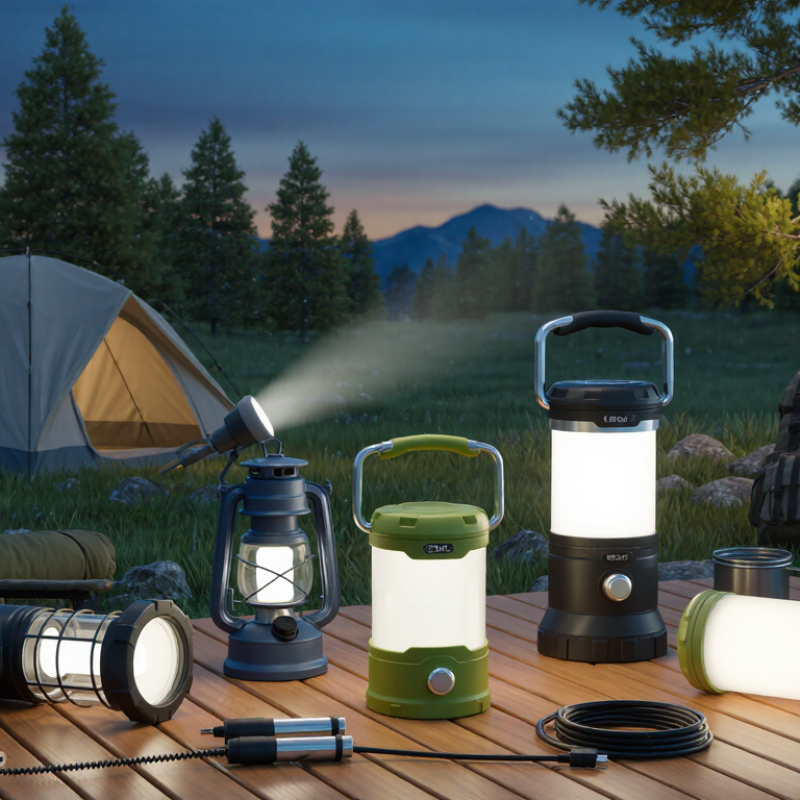
7 Tips to Choose the Best Bluetooth Camping Light

Define Use Cases: Match Brightness to ANSI FL1 Lumens and Beam Distance

Choose a camping light by task, not by its largest lumen number. ANSI/PLATO FL 1-2019 defines measured output in lumens, beam distance, runtime, impact resistance, and water resistance. Its beam-distance test ends when illumination falls to 0.25 lux. That value describes a controlled test, not every dark campsite.

For a small tent, 30–100 ANSI FL1 lumens usually supports reading, packing, and finding gear. Cooking or group use may need 150–300 lumens, especially under a covered shelter. A narrow beam can reach farther, while a wide diffuser lights nearby hands and tables better. I once overestimated beam distance on a bright campsite. The specification looked impressive, but nearby branches scattered the light.

Match beam distance to the surroundings. A 10–20-meter beam suits tent entrances and short paths. Open trails may justify 50 meters or more, but higher output can create glare and drain the battery faster. Check runtime carefully: ANSI/PLATO FL 1-2019 measures runtime until output falls to 10 percent of the initial level. Therefore, a light advertised for 20 hours may become quite dim before morning. Compare regulated output, not only maximum lumens. The U.S. Department of Energy’s Solid-State Lighting research reports show that LED efficiency depends on temperature, drive current, and thermal management. Camping conditions are less controlled. Cold nights can also reduce practical battery performance. Test the light outdoors before relying on it.

Choose a Bluetooth Camping Light by Use Case

Compare practical brightness targets with ANSI FL1 beam-distance readings.

Higher lumens generally provide more overall light, while beam distance indicates how far the light reaches at the ANSI FL1 measurement threshold of 0.25 lux. These planning ranges are suitable for common camping tasks; actual performance also depends on beam shape, battery level, weather, and surface reflectivity.

Verify Bluetooth Range: Compare Class 2’s 10 m and Class 1’s 100 m

When choosing a Bluetooth camping light, verify its connection range instead of trusting the package alone. Class 2 devices typically reach about 10 meters, while Class 1 devices can reach approximately 100 meters under ideal conditions. These figures describe open-air performance, not a crowded campsite with trees, tents, vehicles, and uneven ground. Distance matters. Walls interfere.

I once tested a light beside a tent and assumed the signal had failed at eight meters. The real problem was my phone inside a backpack, surrounded by metal camping cookware. That experience changed my testing method. Place the light outdoors, keep the phone uncovered, and walk away slowly while controlling brightness. Record where commands become delayed or unreliable. Test again near trees and behind the tent. Real results may be far below the advertised maximum.

Class 2 is often enough for a light beside a sleeping area, picnic table, or small tent. Class 1 is more practical when one phone controls several lights across a large campsite. However, range alone should not decide your purchase. Check battery capacity, water resistance, pairing stability, and whether the controls respond quickly after standby. A stronger signal may also use more power, although this depends on the device design. If your campsite is compact, paying for 100 meters may add little value. My earlier mistake was treating maximum range as everyday range. Measure the actual layout you use. Test it twice.

Assess Battery Life: Convert Capacity to Watt-Hours for Runtime Comparisons

Battery capacity is often shown in milliamp-hours, but that number alone can mislead. Convert it to watt-hours before comparing camping lights. The formula is simple:

Wh = Ah × V

A 10,000 mAh battery equals 10 Ah. At a nominal 3.7 volts, it stores about 37 Wh. IEC 61960-3 specifies capacity testing under controlled conditions, so real outdoor results may vary with temperature, age, and discharge rate.

Measure actual power draw, not only advertised brightness. A light using 3 watts could theoretically run for about 12 hours with 37 Wh. Converter losses, Bluetooth activity, and battery protection reduce that figure. Allowing 15–25% loss gives a more realistic estimate of nine to ten hours.

Still imperfect. I once trusted the capacity label and ignored cold weather; the lamp dimmed before dawn.

The U.S. Department of Energy’s 2024 Solid-State Lighting R&D Opportunities report identifies LED packages exceeding 200 lumens per watt in laboratory conditions. A complete camping lamp performs lower because optics, drivers, and controls consume energy. Check runtime at the brightness you actually use. If a report claims 100 hours, ask whether that means moonlight mode. Compare watt-hours, measured watts, and test conditions together. That small calculation reveals more than a large battery number.

Check Weather Protection: Use IEC 60529 IP Ratings for Outdoor Durability

Rain can turn a pleasant campsite into a harsh equipment test. When choosing a Bluetooth camping light, check the IEC 60529 IP rating before judging brightness or battery life. This international standard measures protection against solids and water. The first digit covers dust; the second covers moisture. An IPX4 light resists splashes from all directions. An IPX7 light can survive immersion up to one metre for 30 minutes under laboratory conditions. Field weather is less predictable.

Tip 1: Match the rating to your campsite. For covered patios, IPX4 may be adequate. For exposed campsites, IPX6 offers stronger protection against powerful water jets. IPX7 helps after accidental drops into shallow water, but it does not guarantee safe charging while wet. I once treated a high rating as complete protection. That shortcut was wrong.

Tip 2: Read the full code, not only the final digit. IP67 indicates dust-tight protection and temporary immersion resistance. IEC 60529 defines IPX8 as immersion beyond one metre, but the manufacturer must state the exact conditions.

Tip 3: Inspect seals, charging covers, and speaker openings. A damaged gasket can defeat a certified rating. The U.S. National Weather Service records thousands of severe-weather reports annually, showing how quickly outdoor conditions can change. IP testing is controlled, while wind-driven grit, salt spray, freezing temperatures, and repeated drops are not. Bluetooth performance may also weaken behind wet canvas or dense trees. Check the testing limits carefully. Celsius matters.

(Approx. 220 words)

Compare Safety and Controls: Review Bluetooth Version, Charging, and Certifications

A reliable Bluetooth camping light should pair quickly and remain controllable beside a cold tent. Bluetooth SIG’s 2024 Market Update reports that 5.4 billion Bluetooth devices shipped in 2023, showing how widespread the technology has become. Still, a newer Bluetooth version does not automatically mean stronger range or safer operation. Check whether the light supports Bluetooth Low Energy, stable reconnection, and encrypted communication. Test the controls with wet or gloved fingers.

Charging deserves closer attention. The International Energy Agency reports that battery storage deployment continues to expand rapidly, while safety depends heavily on correct charging and temperature control. Use the supplied cable or a charger with matching voltage and current. Look for overheating, swelling, or a sharp chemical smell. Stop using it immediately. I once trusted a bright indicator too much; the casing still felt warmer than expected.

Certifications reveal more than attractive packaging. IEC 60529 defines IP ratings, so an IPX4 lamp resists splashing but is not designed for immersion. IEC 60598-1 provides general safety requirements for luminaires, while relevant portable-lamp testing can add useful protection checks. A recognized certification mark should include a traceable testing body, not vague wording. The U.S. Consumer Product Safety Commission repeatedly warns consumers about damaged lithium-ion batteries and improper charging. That warning is easy to overlook outdoors. Review battery capacity, charging time, protection circuitry, and certification details before choosing convenience.

7 Tips to Choose the Best Bluetooth Camping Light - Compare Safety and Controls: Review Bluetooth Version, Charging, and Certifications

Tip Data Dimension Recommended Benchmark Why It Matters What to Check Before Buying
1Bluetooth Version Wireless communication standard Bluetooth Low Energy, version 5.0 or newer Bluetooth Low Energy generally supports lower power consumption and improved connection reliability compared with older Bluetooth generations. Confirm the Bluetooth version in the technical specifications and check whether the light supports the operating system used by your phone.
2Connection Range and Control Remote operating distance and functions At least 10 m in open conditions; dimming, timer, grouping, and battery-status functions Actual range decreases when walls, vehicles, trees, or other obstacles block the signal. Useful controls can reduce the need to handle the light in darkness. Look for a clearly stated open-air range, adjustable brightness, color-temperature control if needed, timer settings, and a physical manual control as a backup.
3Battery and Charging Battery type, charging connector, and protection Rechargeable lithium-ion battery with protected charging circuitry and a sealed USB-C or comparable input Overcharge, over-discharge, short-circuit, and overheating protection help reduce battery-related risks. A common charging connector improves convenience in the field. Check the rated battery capacity in watt-hours or milliamp-hours, charging voltage, charge time, cable requirements, and whether the battery is replaceable or serviceable.
4Weather Resistance Ingress Protection rating IPX4 for splash resistance; IP65 or higher for stronger dust and water protection IP ratings are defined under IEC 60529. The first character addresses solid-particle protection, while the second addresses water protection. Check the complete IP code rather than relying on terms such as “weatherproof.” Verify that the charging-port cover is closed when the rating is claimed.
5Electrical Safety Construction and safety testing Evidence of testing against applicable luminaire requirements, such as IEC 60598-1 or a relevant national equivalent Applicable luminaire standards address areas such as insulation, abnormal operation, wiring, mechanical construction, and protection against electric shock. Review the product manual, rating label, test report, or declaration supplied by the seller. Do not treat a marketing symbol alone as proof of independent testing.
6Battery Transport and Handling Lithium-battery documentation UN 38.3 test evidence for the lithium battery or battery pack UN 38.3 covers transport-related testing for lithium cells and batteries, including tests involving altitude simulation, temperature cycling, vibration, shock, and external short circuit. Ask for the battery model, nominal voltage, capacity, and UN 38.3 test summary where relevant. Never use a swollen, damaged, or overheating battery.
7Certification and Product Claims Wireless qualification and regional compliance Bluetooth qualification plus applicable electrical, radio, and battery compliance for the destination market Bluetooth products are expected to comply with the Bluetooth qualification process. Regional compliance requirements may also cover radio emissions, electrical safety, electromagnetic compatibility, and batteries. Check the manufacturer’s declaration, test documentation, model number, rated input, and destination-market markings. Remember that a CE mark is a manufacturer’s conformity declaration, not automatically proof of independent certification.

Comparison note: Ratings and test requirements can vary by product design and destination market. Always compare the exact model’s label, manual, battery specifications, ingress rating, and supporting compliance documents before purchase or outdoor use.

We have the largest selection of new, remanufactured and quality pre-owned office furniture in the tri-state area.  We ship nationwide with regular deliveries to Pittsburgh, Erie, Uniontown, Washington, Akron, Cleveland, Beckley, Charleston, Clarksburg, Huntington, Morgantown, Parkersburg, Wheeling, Ashland, Ironton, and Lexington.

PITTSBURGH, PA

Showroom & Corporate Offices
1 Sexton Road
Pittsburgh, PA 15136

Local: (412) 771-0760
Fax: (412) 771-0764

WHEELING, WV

By Appointment Only
Local: (304) 232-0727

CHARLESTON, WV

Showroom
125 Lakeview Drive, Suite G
Cross Lanes, WV 25313

Local: (304) 345-3773
Fax: (681) 265-9039

MORGANTOWN, WV

By Appointment Only
Local: (304) 381-9119

HOURS OF OPERATION:

MONDAY-FRIDAY: 9am-5pm
SATURDAY: By Appointment