
Largest Selection of New and Used Office Furniture! Call 1-855-885-3375 or visit a showroom today!
Choosing a Montessori Low Chair manufacturer in China takes more than comparing product photos and quoted prices. Buyers need to understand how each supplier handles child-sized proportions, smooth edges, stable joints, and repeatable production. Details matter. A chair should let a young child sit with feet supported and reach a low table without wobbling. Ask for evidence. Request dimensions, material specifications, finish information, and clear photos of actual production samples. A polished catalog alone cannot confirm quality.
For this guide, “best” means a supplier whose products, communication, and quality checks fit a buyer’s needs—not simply a name that appears often online. When comparing manufacturers, look for relevant woodworking experience, documented inspection steps, sample consistency, protective packaging, and realistic lead times. Ask how the factory selects materials, applies finishes, checks stability, and handles repairs. Then review written quotations carefully; a low price may exclude finishing, packaging, or sample costs. Small omissions can become costly.
No public list can replace direct verification, and supplier claims deserve checking. If possible, inspect a sample and test its balance on a level floor. Notice the underside, screw covers, and how the chair feels after repeated use. A minor flaw? It may point to a process gap, though one sample cannot tell the whole story. The sections ahead offer practical ways to assess manufacturers, compare options, and ask better questions before ordering. Product needs differ by age range, room layout, and daily use.
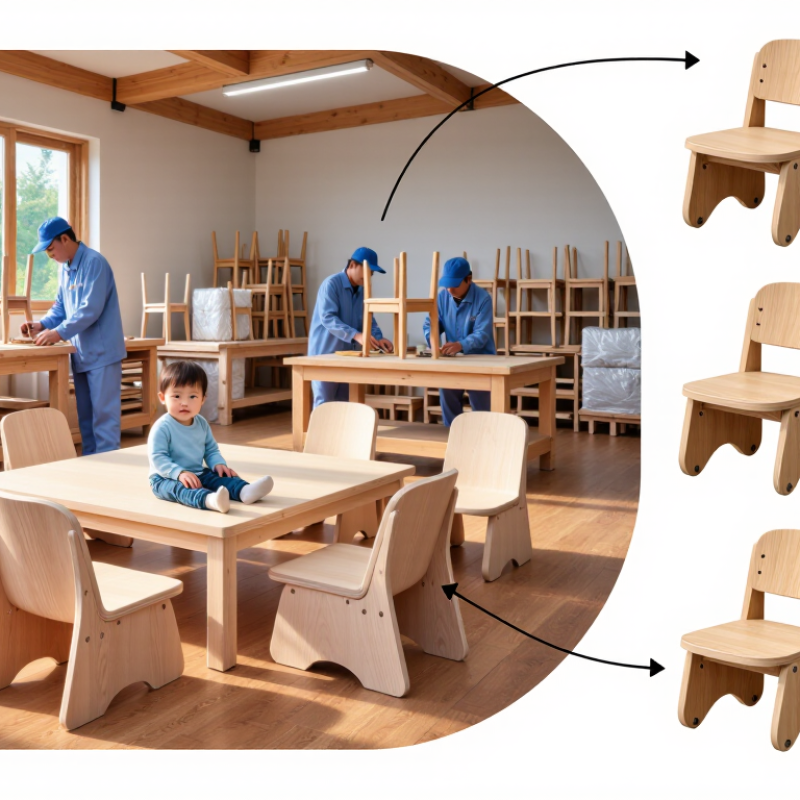
A Montessori low chair is defined less by its appearance than by how a child can use it. The seat should let a child sit down and stand up independently, with feet resting on the floor and knees bending comfortably. A stable base, smooth edges, and a seat depth that does not press behind the knees matter more than decorative cut-outs. That is the point. There is no single universal seat height for every child; fit depends on the child’s body and the table used alongside the chair.
For a useful technical reference, EN 1729-1:2015, a European educational-furniture standard, specifies seat heights of 210 mm for size 0 and 260 mm for size 1 chairs. These figures are benchmarks, not proof that a chair is Montessori or right for every child. Check fit in person: a child should sit with feet supported, hips near the back of the seat, and hands able to reach the work surface without raised shoulders. A chair can be low and still be uncomfortable. That detail is easy to overlook. Consider the floor, too; a chair that slides or rocks can make independent use harder. Measurements help, but observing the child at the table matters just as much.
A Montessori low chair is sized to help a child sit down and stand up independently, with feet supported and a comfortable seat depth.
The chart shows general ergonomic fit references, not a universal Montessori standard: seat height should roughly match the child’s popliteal height (floor to the back of the knee), while seat depth is commonly kept shorter to leave space behind the knees. Check that the child can sit with feet flat and knees comfortably bent.
A low chair should let a child sit with feet supported and knees comfortably bent. The WHO Child Growth Standards report gives median heights at 24 months of 87.1 cm for boys and 85.7 cm for girls. Height alone, however, cannot determine seat height; children’s leg proportions vary. Ask manufacturers for seat-height options and measurements, then check fit with the child seated. A chair that looks tiny in a catalogue may still feel too high.
For frames, solid beech or birch plywood can offer a durable, smooth surface when joints are well finished. Request material specifications and finish information, not just phrases such as “child-safe.” Rounded edges, stable legs, secure joints, and no accessible pinch points deserve close inspection. Small details matter. Ask for test documentation against relevant children’s seating standards, such as ASTM International’s F2613 specification. A certificate summary is useful, but a current test report gives more context.
Check dimensions in millimetres, including seat height, seat depth, and overall width. Compare these with the child’s seated posture, rather than choosing by age label alone. A practical sample check: place the chair on a hard, level floor and gently test for wobble. This is not a substitute for laboratory testing. It is still a useful reminder that attractive wood grain cannot prove stability.
How Montessori Low Chairs Are Manufactured in China
Manufacturing begins with a drawing that fixes seat height, leg angle, and rounded edges. Designers match these dimensions to the intended age range. Samples are often built before production, then checked for wobble on a level floor. Small differences matter.
Factories select solid wood or engineered panels based on strength, appearance, and cost. Timber is dried and inspected for defects; panels are cut with CNC machines, then drilled, sanded, and assembled. Workers check joints by hand, because a precise machine cut cannot guarantee a tight fit. Finishes are applied in controlled coats and allowed to cure before inspection. Edges should feel smooth, not merely look smooth.
Quality checks commonly cover dimensions, stability, fasteners, surface finish, and packaging. Buyers should request test records and material details rather than rely on product photos. China’s National Bureau of Statistics reported 655.6 billion yuan in 2023 operating revenue for furniture manufacturers above designated size. This is sector-wide data, not a count of Montessori chairs, so it offers context rather than proof of any factory’s quality. A useful audit also checks how defects are recorded; some workshops still rely too much on visual judgment.
| Manufacturing Stage | Typical Work | Materials or Equipment | Common Quality Checks |
|---|---|---|---|
| Product design | Develop the chair dimensions, seat height, leg geometry, and connection details for the intended age group and use. | Drawings, prototypes, and product specifications. | Review dimensions, stability requirements, edges, and overall usability before production. |
| Material selection | Select suitable wood-based components and finishes based on the product design and order requirements. | Solid wood or wood panels; compatible adhesives and surface finishes where specified. | Check material condition, visible defects, moisture-related issues, and consistency with the specification. |
| Cutting and machining | Cut the seat, backrest, legs, and supports; machine profiles and connection points. | Saws, routers, drilling equipment, and CNC machines where used. | Compare component dimensions and hole or joint locations with the approved drawings. |
| Edge shaping and sanding | Round or smooth exposed edges and sand surfaces to prepare components for assembly and finishing. | Manual or powered sanding tools and suitable abrasives. | Check for splinters, sharp edges, rough areas, and visible surface defects. |
| Assembly | Join the chair components using the specified joints, fasteners, and adhesive, if applicable. | Clamps, assembly fixtures, fasteners, and adhesive where specified. | Inspect joint fit, alignment, rocking, and overall structural stability. |
| Surface finishing | Apply the specified finish and allow it to dry or cure according to the finish instructions. | Paint, clear coat, or other specified finish; application and drying equipment. | Check finish coverage, appearance, adhesion, and drying or curing condition. |
| Final inspection | Review the completed chair before it is packed for shipment. | Inspection checklist and measuring tools. | Check appearance, dimensions against the order specification, stability, and assembly. |
| Packaging | Protect the chair or its components for storage and transport; include assembly instructions when required. | Protective wrapping, cartons, and packing materials. | Confirm the correct parts and documents are included and that the package is adequately protected. |
| Note: This table describes common furniture-manufacturing steps. Materials, machinery, inspection methods, and production sequences vary by product specification and factory; it does not rank or identify individual manufacturers. | |||
A low chair can look simple in a catalog, yet small design differences affect daily use. When evaluating Chinese manufacturers, check seat height, width, edge radius, and overall stability against your needs. Ask for a dimensioned drawing, not just a product photo. A chair that suits a toddler at one table may feel awkward at another.
Review the materials and the process behind them. Ask what wood or board is used, how surfaces are finished, and how joints are checked. Request a sample and inspect it under ordinary room lighting. Look for rough edges, uneven coating, wobble, or gaps around joints. Ask how the manufacturer tests load and repeated use, and request records for the specific model. A polished sample is useful, but it cannot prove every production unit will match. That part deserves a closer look.
Tips: Send the same checklist to each supplier. Compare sample measurements with the drawing, and ask who handles final inspection. Confirm packaging with a drop or handling test plan, especially if chairs will be shipped long distances. Keep answers in writing. If a response is vague, ask one precise follow-up; even then, some uncertainty may remain.
When comparing Montessori low chair manufacturers in China, look beyond polished product photos. Ask how each batch is checked for wobble, sharp edges, loose joints, and uneven leg length. A chair should sit firmly on a flat floor, with rounded corners and a smooth finish that does not splinter under light sanding. Small details matter. Request inspection records and clear pass-or-fail criteria, not just a verbal promise of quality.
Customization works best when measurements are settled before production. Share seat height, overall width, wood or panel preferences, finish requirements, and target age range in a written specification. Ask for a pre-production sample, then check it with a tape measure and by placing it on the intended flooring. A sample can look excellent and still differ from the full run. That gap matters. Confirm how changes are approved and recorded.
For export, discuss carton strength, protective padding, labeling, and shipping terms early. Ask whether packed samples can withstand ordinary handling, and confirm the documents and product details your destination market requires with a qualified logistics provider. Moisture can affect wood during long transit, so clarify how materials are dried and stored. Timelines may shift, especially when custom finishes are involved. Build in room for review rather than relying on an optimistic delivery date.