How to Choose the Best Wooden Doors in 2026
Choosing Wooden Doors in 2026 means balancing appearance with performance, cost, and the conditions in your home. A warm oak door can suit a bright hallway, while a painted timber design may feel more at home in a small, busy kitchen. Yet the finish is only part of the decision. Consider whether you need a door for a bedroom, bathroom, entryway, or another space before comparing styles.
Start with construction. Solid-wood doors offer natural grain and can often be refinished, but their movement may vary with changes in humidity. Engineered options can provide more consistent construction, though quality differs between products. Ask what the core and outer layers are made from. Check the product specifications, care instructions, warranty, and suitability for the intended location. Details matter. A beautiful door that sticks against a damp bathroom frame is not a good fit.
Measurements and installation deserve equal attention. Confirm the opening size, frame condition, door swing, and hardware requirements before ordering. For exterior use, check the manufacturer’s guidance on weather exposure, sealing, and maintenance. Request samples when possible; wood tones can look quite different beside your flooring or in evening light. Set a realistic budget that includes handles, finishing, delivery, and fitting—not just the door itself. There is no single best choice. The most reliable decision comes from matching documented product details to your space, then checking the result with a qualified installer when the fit or specification is uncertain. Some trade-offs remain, and that is worth admitting.
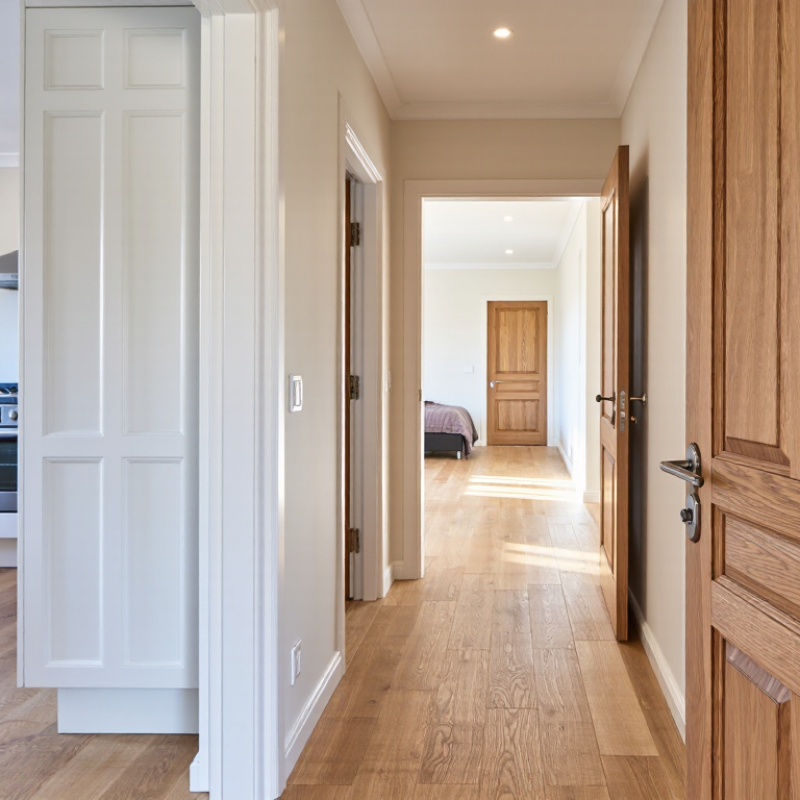
Define the Door’s Role and Check Code Requirements for 20–90-Minute Fire Ratings
How to Choose the Best Wooden Doors in 2026
Define the Door’s Role and Check Code Requirements for 20–90-Minute Fire Ratings
A wooden door for a bedroom has different demands from one protecting a corridor or stairwell. Identify the opening’s purpose, wall type, and expected traffic before comparing finishes or cores. For fire protection, the rating applies to a tested assembly—not simply a wooden door leaf. The frame, glazing, hinges, latch, and installation details matter too. Small details count.
The 2021 International Building Code, Table 716.1(2), assigns opening-protective ratings according to the wall and opening type. Its listed options include 20-, 45-, 60-, and 90-minute ratings. These numbers are not interchangeable upgrades. A higher rating may be unnecessary, while a lower one may not satisfy the approved plans. Check local requirements and ask the building official or qualified specifier to confirm the required assembly before ordering.
Look for documentation showing that the complete assembly was tested and listed for the intended use. Confirm the label remains visible, and avoid unapproved trimming or hardware changes; even a neat field adjustment can affect compliance. NFPA 80 (2022) calls for fire door assemblies to be inspected and tested annually, with records maintained. That ongoing check is easy to overlook. Review the inspection history, closing action, seals, and visible damage, especially around a busy doorway. A rating on paper is only useful when the installed door still operates as intended.
Compare Core Types Using Published STC Ratings and Sound-Control Needs
When comparing wooden doors, treat published Sound Transmission Class (STC) ratings as test results for a complete assembly, not a promise about the door leaf alone. A solid-core door often blocks more sound than a hollow-core door, but construction varies. Check whether the listed rating includes the frame, perimeter seals, and threshold. Small gaps matter. A bright line of light beneath a closed door can also mark an easy path for sound.
For bedrooms beside busy hallways, compare tested solid-core assemblies and look for documented ratings suited to the space. For a home office, a well-sealed door may be more useful than a higher-rated leaf fitted loosely. Solid-wood doors can be substantial, yet weight alone does not establish sound performance.
Glazed panels may change the result; ask for test data covering that exact configuration. STC testing uses controlled conditions, so real rooms can perform differently because of flanking sound through walls, vents, or ceilings.
That part is easy to overlook. I would compare the rating, installation details, and the actual noise source together, rather than choosing by core label alone.
Select Wood Species, Veneer, and FSC Certification for Durability and Sourcing
Choosing a wooden door starts with its setting, not just its color. Oak and maple are hard-wearing options for busy rooms, while softer species may dent more easily. That is not always a deal-breaker. A well-made door with a durable finish can suit a quieter space, but ask how it handles humidity and daily use.
Veneer can deliver the look of a prized wood while using less of it. Check the door’s core, veneer thickness, and edge sealing; these details affect stability and repair options. A thin decorative layer may be difficult to refinish, so clarify care instructions before buying. Look closely at sample edges. They tell a story.
For sourcing, seek current FSC certification information and confirm what the claim covers: the wood, the product, or the supply chain. Certification can support responsible forestry, but it does not guarantee a door’s lifespan or craftsmanship. Ask for documentation, then compare it with the product description. I would not choose on a label alone; construction quality, fit, and a finish suited to local conditions matter just as much. Sometimes the best choice is less obvious.
Compare Exterior-Door U-Factors on NFRC Labels and ENERGY STAR Criteria
A wooden entry door can feel solid yet still leak heat around its frame. Compare the NFRC label’s U-factor, which measures heat transfer through the rated door assembly. The rating is expressed in Btu/(h·ft²·°F). Lower is better. For example, a door rated 0.20 transfers about one-third less heat than a 0.30-rated door under the same conditions. That comparison assumes equal area and temperature difference; installation gaps can undermine it.
ENERGY STAR’s residential-door criteria set U-factor limits according to climate zone and glazing area, so compare the exact category—not just the logo. Its criteria tables are a practical screening tool, while the NFRC rating helps compare tested products on a consistent basis. Check whether the label covers the complete door, including frame and glass, and confirm the rating matches the configuration you plan to buy. A decorative glass panel may change the result. So can a threshold that does not seal tightly. I’d be tempted to choose the lowest number, but a poorly fitted door can erase much of that advantage. Ask the installer how they will seal the jamb and sill, then keep the product label with your project records.
How to read an NFRC label: Compare the door’s NFRC U-factor with the applicable ENERGY STAR maximum shown here. A lower U-factor means less heat transfer. Eligibility can depend on additional program requirements, so check the current criteria for the door and market you are considering.