
Largest Selection of New and Used Office Furniture! Call 1-855-885-3375 or visit a showroom today!
Choosing an Electric Marine Toilet is less about selecting the most polished control panel and more about matching the unit to your boat’s systems. Measure the available space, including room to open the seat and reach service connections. Check the toilet’s voltage, wiring requirements, water supply, discharge arrangement, and compatibility with your existing holding tank. A quiet pump can matter in a small cabin, especially at night. So can the flush-water demand on a boat with limited freshwater capacity.
Marine-systems author Nigel Calder’s practical, systems-based perspective can be summarized this way: “Choose equipment for how it works with the whole boat, not for one impressive feature.” This is an editorial paraphrase, not a verbatim quotation. Before buying, compare the manufacturer’s installation manual with your boat’s actual layout. Look closely at hose routes, access for maintenance, and the space around the base. Ask a qualified marine technician if electrical or plumbing changes are unclear. Small details matter.
There is no perfect choice for every vessel. A compact model may save space but feel cramped; a quieter flush may use more water. It is easy to overlook service access. I would not choose from product photos alone. This guide explains the key specifications, practical trade-offs, and questions to ask before choosing an Electric Marine Toilet for your boat.
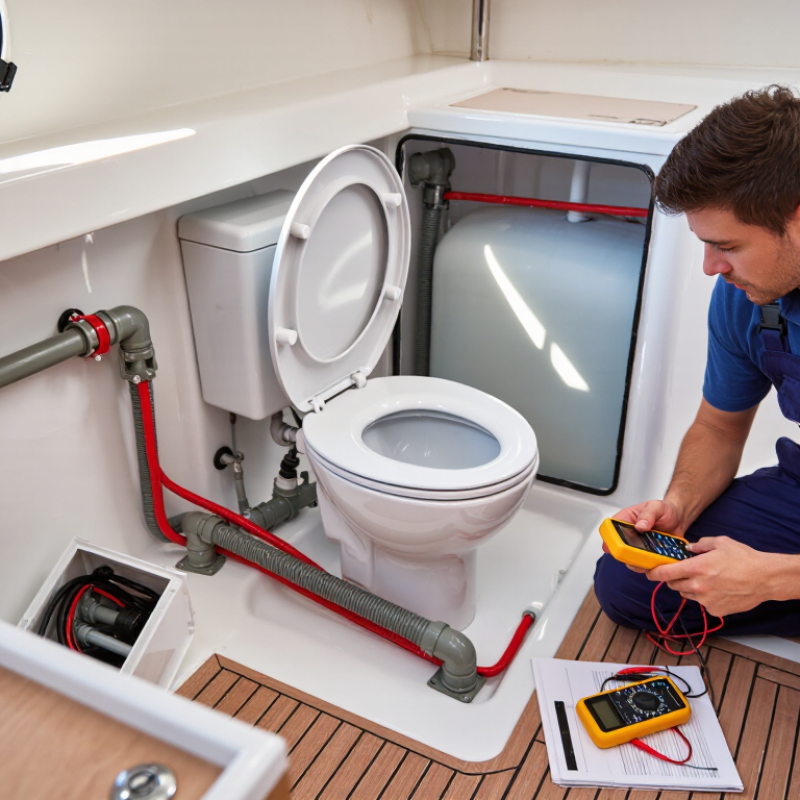
An electric marine toilet converts a switch press into a controlled rinse and waste-pumping cycle. A small motor drives a pump or macerator, moving waste through a discharge hose to a holding tank or approved treatment system. Rinse water may come from the boat’s freshwater supply or a separate seawater intake.
Small motor, steady flow. The plumbing choice affects water use, odor control, and maintenance.
The U.S. Coast Guard’s Type I marine sanitation device standard sets an effluent limit of 1,000 fecal-coliform bacteria per 100 milliliters and 150 milligrams of suspended solids per liter (33 CFR §159.53). These figures describe treatment performance, not what every electric toilet achieves.
A macerator reduces particle size; it does not, by itself, disinfect waste. That distinction matters.
In practice, check the wiring, fuse, hose diameter, and tank capacity against the boat’s layout. A long, sharply bent discharge hose can make pumping harder.
And freshwater flushing may draw from the same limited supply used for drinking. It is easy to overlook that trade-off.
Before choosing an electric marine toilet, measure the available space, not just the old bowl’s footprint. Check knee room, door clearance, and access to fasteners for future servicing. A unit may fit neatly at the dock but feel cramped when the boat is moving. Small details matter. Also map the route to the holding tank. Long hose runs, tight bends, and hard-to-reach connections can complicate installation and maintenance.
Tips: Measure twice, including seat height and service clearance. Confirm the toilet’s voltage against the boat’s electrical system. Check the installation manual for current draw, recommended wire size, fuse rating, and plumbing requirements. Do not guess.
Inspect the battery, wiring, and existing plumbing before buying. Undersized wires or a long cable run can cause voltage drop, while an aging battery may struggle during flushing. Use marine-grade wiring and suitable circuit protection as specified by the manufacturer. Verify that intake and discharge hoses match the planned layout, and check whether the system needs a vented loop or other plumbing components. I would not assume an existing installation is correct just because it works today. If the wiring or sanitation layout is unclear, ask a qualified marine technician to inspect it before installation.
Electric marine toilets differ mainly in how they move waste. A macerating model grinds waste and pumps it through a discharge hose, so it can fit where a conventional gravity toilet cannot. Vacuum-flush systems use less rinse water per flush, but need a vacuum pump, seals, and extra service access. That matters. Compare the toilet’s rated voltage, flush-water use, and current draw with your boat’s electrical system; check the maker’s specifications rather than assuming every 12-volt model behaves alike. A quiet flush is pleasant, but a pump that strains when the battery is low is not.
Installation space often decides the choice. NMMA’s 2023 Recreational Boating Statistical Abstract reports that about 95% of boats on the water are under 26 feet, where clearance and storage are commonly tight. Measure the bowl, seat opening, hose route, and space needed to remove the pump before buying. Leave room to reach clamps and wiring. A tight bend in a sanitation hose can complicate service, while an undersized wire run can reduce pump performance; follow the installation manual and have a qualified marine technician verify the circuit when needed. Check holding-tank capacity against crew size and trip length, too. One overlooked detail is service access: a neat installation can still be frustrating if a pump sits behind a fixed panel. There is no perfect layout.
Match the toilet to the people aboard and the way they use the boat. Count overnight guests, trip length, and likely time between pump-outs. A small day boat with two people has different needs from a cruiser carrying a family for several nights. Capacity is not just tank size. It also depends on water use and how often the toilet is flushed. Short trips can hide a poor fit.
Electric models vary in flush-water source, macerator design, control type, and power draw. Check the unit’s voltage and current requirements against your boat’s electrical system, especially when batteries are already powering lights and navigation equipment. A strong flush may be useful, but it can consume more water or power. Read the installation limits carefully. Measure the space, hose route, and service access before buying; a neat cabin sketch can miss awkward bends and cramped tool clearance. That part is easy to underestimate.
Choose features around real routines. A freshwater flush may suit a boat with ample water, while a seawater-fed system can conserve stored freshwater. Confirm that the chosen setup matches the plumbing and waste tank arrangement onboard. For overnight use, consider noise, bowl height, and whether guests can operate the controls without instructions. A quiet motor matters more in a small cabin at night. Still, specifications cannot predict every crew’s habits. A little extra capacity may feel reassuring, though it can take up space needed for storage. Decide which trade-off your trips can live with.
When comparing electric marine toilets, price the installation as a system, not a bowl. Check the boat’s voltage, available battery capacity, wire route, breaker, and discharge-hose space before buying. A tight head compartment can turn a simple replacement into a half-day job.
The U.S. Bureau of Labor Statistics reported a 2024 median annual wage of $62,350 for electricians; this is a broad labor benchmark, not a marine-service quote. Ask a marine technician for an itemized estimate, including wiring and fittings.
Maintenance costs depend on use and access. Inspect hose clamps, wiring connections, and seals regularly; leaks behind a cabinet are slow to notice and costly to reach. Keep compatible seals and a service kit aboard. Small parts matter.
For energy, measure the toilet’s actual draw rather than relying on a guess. As a simple illustration,
1 watt-hour per flush × 10 times daily = 3.65 kWh yearly
At the U.S. Energy Information Administration’s 2024 residential average of 16.48 cents per kWh, that is about 60 cents annually at shore power. Battery losses and charging sources change the real cost. This estimate is deliberately narrow: service parts and labor usually deserve more attention than flush electricity.