
Largest Selection of New and Used Office Furniture! Call 1-855-885-3375 or visit a showroom today!
A Mesh Playpen can create a safer place for short periods of supervised play, but its soft appearance can be misleading. The U.S. Consumer Product Safety Commission’s Nursery Products Annual Report identifies falls, entrapment, structural failures, and unsafe sleep use as recurring nursery-product hazards. These risks are not theoretical. A loose side, torn mesh panel, or misplaced toy can change the environment quickly.
Safety guidance from the American Academy of Pediatrics recommends keeping babies away from cords, pillows, blankets, and other suffocation hazards. ASTM F1004 also provides performance requirements for play yards, including stability, openings, and structural strength. Look for clear compliance information, complete product instructions, and reliable recall records before buying. A reputable manufacturer should provide its model number, age and weight limits, testing information, and replacement-part support.
Check every seam.
Press the frame gently. It should not wobble, fold, or twist unexpectedly. Run your fingers across the mesh and inspect the corners, hinges, fasteners, and floor connections. The openings should not trap tiny fingers, clothing, or pacifier clips. Place the playpen on a flat floor, away from stairs, windows, heaters, blinds, and furniture that a child could climb. Never treat a Mesh Playpen as a substitute for attentive supervision or a certified sleep space.
Some product pages use vague claims such as “breathable” or “premium safety.” Those words prove little. A careful choice depends on measurable features, current safety guidance, and honest inspection. Even then, my own checklist has limits: babies move unpredictably, and equipment can wear faster than expected. Recheck it before every use.
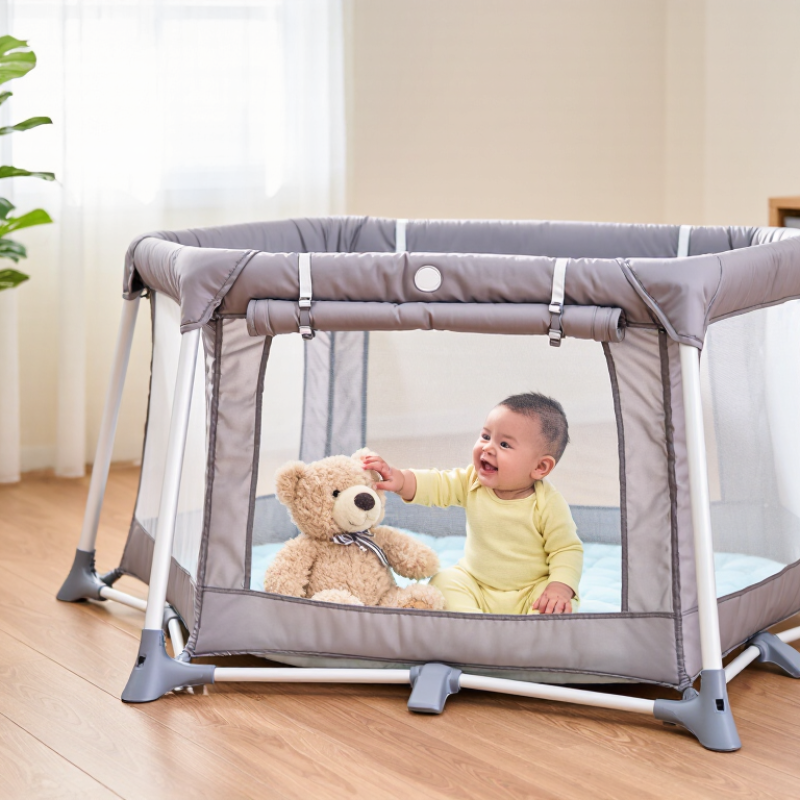
A safe mesh playpen should meet the safety expectations described in ASTM F406 and applicable CPSC play yard requirements. ASTM F406 addresses structural strength, side height, locking parts, mattress fit, and entrapment risks. CPSC rules rely on related safety requirements for play yards sold in the United States. Ask the seller for clear compliance information and testing documentation. Do not accept vague claims.
Inspect the playpen in person when possible. The frame should open fully and lock firmly. Press each corner gently. It should not twist, collapse, or show sharp edges. Check the mesh for loose threads, tears, or openings that could catch tiny fingers. The floor mattress should fit tightly, without gaps along the sides. Avoid adding extra padding. It may look more comfortable, but it can create a suffocation hazard. Follow every instruction, even when the design seems obvious.
Tips: Check every lock before use. Keep cords, pillows, and toys outside the play area. Place the playpen on a flat floor, away from windows and heaters. Stop using it if the frame bends or the mesh loosens. A standard is valuable, but it is not a substitute for supervision. I would also recheck the playpen after moving it, because small setup mistakes are easy to miss.
A safe mesh playpen should remain steady when your baby leans, rolls, or pulls upward. Check the base on a hard, level floor. Press each corner gently. The frame should not rock, slide, or fold unexpectedly. Examine every joint for gaps, loose stitching, and bent tubing. Stability matters more than attractive colors or extra accessories.
ASTM F406 provides performance requirements for non-full-size cribs and play yards, including structural strength, locking systems, openings, and side construction. Use its current edition when checking the playpen’s documented compliance. Test every folding mechanism before use. A locked frame should give a clear, complete engagement. Do not rely on a soft click alone. Pull the rails upward and sideways, then repeat after folding and reopening. Measure side height from the reference points defined by the standard, not from an improvised location. The supplied mattress or floor insert can change the usable height. This detail is easy to miss.
Tips: Keep the playpen empty except for its approved floor pad. Remove pillows, thick blankets, and hanging toys. Check mesh tension with two fingers. Loose mesh needs attention. Reinspect after moving the playpen. I would not treat a passed first inspection as permanent proof of safety. Hardware can loosen, and small tears can grow quickly. Keep the assembly instructions and compliance information nearby for careful comparison.
A safe mesh playpen needs more than a bright, clean appearance. During a hands-on inspection, stretch each mesh panel gently and examine the openings against a rigid ¼-inch screening gauge. This is a practical warning reference, not a certification test. Openings that appear larger, uneven, or stretched deserve closer attention. Small gaps matter. A baby’s fingers, toes, or clothing can catch where the mesh meets the frame.
Inspect every seam, especially at corners, folded edges, and zipper ends. Run a clean fingertip along the stitching. Loose threads, hard plastic edges, or separated binding can create snagging and entrapment hazards. Check whether the mesh pulls away from the frame when pressed from inside. The U.S. Consumer Product Safety Commission reported an estimated 59,500 emergency-department-treated injuries linked to nursery products among children under five in 2022. That figure supports careful inspection, not panic. ASTM F406 testing is more precise than household checking, so a ¼-inch screen should not replace compliance verification.
Tips: Place the playpen on a flat floor and inspect it at eye level. Test each zipper slowly. Look closely. Remove any unit with torn mesh, widened openings, exposed stitching, or a frame that twists. Recheck after washing or moving it; repeated folding can enlarge weak seams. I would also photograph questionable areas before deciding, because small defects are easy to dismiss in a rushed room.
A mesh playpen should support safe sleep, not replace it with decoration. The American Academy of Pediatrics (AAP) recommends a firm, flat, non-inclined sleep surface with only a fitted sheet. The mattress should not sag under a baby’s weight. Do not add pillows, blankets, bumpers, toys, or aftermarket pads. They may look comfortable. They can increase suffocation risks.
Check the playpen on the floor before each use. Press the mattress corners. Look for gaps, loose fabric, torn mesh, or a folding frame that does not lock firmly. A practical rule is simple: if the baby’s face could press into it, remove it. The U.S. Consumer Product Safety Commission advises using products that meet current play yard requirements and checking recall notices. That step takes minutes.
The CDC recorded about 3,700 sudden unexpected infant deaths in 2022. About 1,140 involved accidental suffocation or strangulation. These figures do not prove that every unsafe product causes harm, but they demand careful choices. A firm surface may seem too hard to adults. For infants, that firmness matters. I would still recheck the setup after washing the sheet or moving the pen. Small changes are easy to miss.
A safe mesh playpen starts with its weight limit, not its color or advertised features. Check the label for the maximum child weight, recommended age, model number, production date, and importer details. The limit should include the baby’s movement and any permitted accessories. Never assume a larger playpen supports more weight. That mistake is easy to make.
Inspect the mesh under bright light. Look for loose stitching, torn panels, wide openings, sharp fasteners, or rails that fail to lock firmly. Press each corner and gently shake the frame. It should remain stable on a flat floor. Read every warning, including instructions about folding, assembly, and unsuitable use. A playpen is not automatically a safe sleep space.
Check official recall databases in your country using the exact model number, not only the product name. For 2025 safety certification, request a current certificate, testing standard, issuing laboratory, certificate number, and test scope. Then verify those details through the certifier’s official records. A printed badge can look convincing. It may still be outdated. Certification requirements differ between markets, so vague claims deserve caution. I would photograph the label before buying and keep the receipt afterward. My own checklist is not perfect, especially when online listings hide small warnings, so another adult should review the details before use.