
2026 Top Inflatable Dome Types for Global Buyers?

Choosing the right Inflatable Dome in 2026 requires more than comparing attractive product photos. Global buyers need to examine structure, climate performance, operating costs, and supplier support. Air-supported domes suit large venues, warehouses, sports courts, and temporary event spaces. Air-beam domes offer simpler installation and flexible layouts. Hybrid designs can combine insulated panels, transparent sections, and reinforced entrances.

Materials matter. PVC-coated polyester remains common because it balances strength, weight, and cost. TPU membranes may provide improved flexibility and surface performance in demanding conditions. However, no material works equally well everywhere. Hot sunlight, heavy rain, snow loads, coastal air, and strong winds can change the purchasing decision. Ask for tested load data, fabric specifications, seam details, blower redundancy, anchoring plans, and emergency maintenance procedures.

Real project experience also reveals less visible concerns. Condensation can affect equipment and visitor comfort. Continuous blower noise may matter near residential areas. A large dome can look simple, yet site preparation may take several days. Some suppliers explain these limits clearly; others do not. That difference matters.

The best choice depends on use, location, capacity, and operating hours. Buyers should verify local building, fire, electrical, and environmental requirements with qualified professionals. Certification documents should match the actual model, not a similar product. This guide compares leading Inflatable Dome types for 2026, while recognizing that rankings are never universal. A reliable solution is not always the cheapest one. Sometimes, the overlooked detail decides everything.
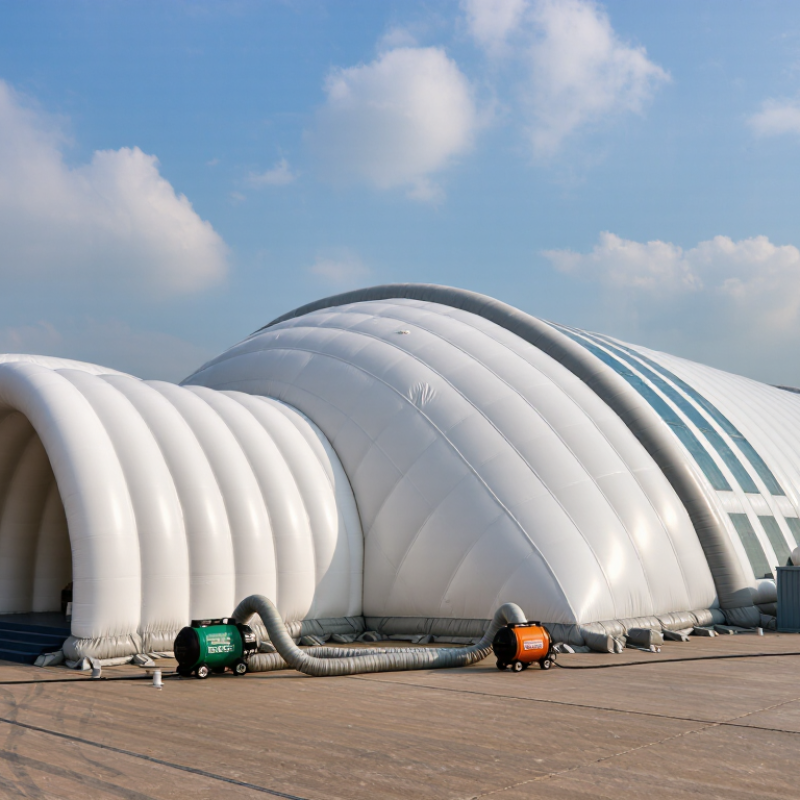
2026 Top Inflatable Dome Types for Global Buyers?

Inflatable Dome Fundamentals: 200–500 Pa Pressure and Three Core Designs

For global buyers, an inflatable dome is more than a soft roof. Its performance depends on pressure, fabric, anchoring, and maintenance. Pressure matters. Many air-supported systems operate around 200–500 pascals (Pa), but the exact figure depends on span, fabric, doors, climate, and anchoring. This pressure is low compared with tire pressure, yet it keeps a large membrane stable. During site checks, pressure should be measured continuously, rather than confirmed by one commissioning reading.

The first core design is the single-layer air-supported dome. Fans maintain interior pressure, while the membrane transfers wind and snow loads toward perimeter anchors. It offers clear interior space and fast installation.

The second is the double-layer cushion dome. Air fills the gap between two membranes, improving insulation and reducing condensation risks when ventilation is designed correctly.

The third is the air-beam dome. Separate inflatable beams form a frame, while panels close the spaces between them. It can simplify repairs because one beam may be isolated. However, more seams and fittings create more inspection points.

Selection should follow use, not appearance. An event venue may value open space, while a cold-climate sports facility needs stronger thermal control. Ask for pressure records, fabric test data, emergency power plans, anchor calculations, and maintenance intervals. Local snow and wind data should be reviewed by a qualified engineer. Small details matter. A door left open can reduce pressure quickly. Specifications may look impressive but ignore crowded entrances and dirty filters. That gap between brochure conditions and daily operation deserves honest review.

2026 Type Map: Air-Supported, Air-Beam, and Double-Membrane Domes

The 2026 dome market is separating into three practical types: air-supported, air-beam, and double-membrane structures. Each responds differently to climate, site access, energy use, and operating habits. Buyers should compare installed performance, not appearance alone.

Air-supported domes use continuous internal air pressure to hold a large membrane in shape. They suit sports halls, storage areas, and seasonal venues with clear interior space. However, doors, seams, and power systems need careful planning. A backup blower and emergency power are not optional details. Air-beam domes use inflated structural tubes, while the outer fabric remains relatively independent. They usually need less constant air management and can offer simpler entry arrangements. Their beams may create more visible internal lines, which some operators dislike.

Double-membrane domes combine two fabric layers with an air cavity between them. This space can improve insulation and reduce condensation when designed correctly. It may also support better temperature stability during cold nights. Site inspections should check snow, wind, drainage, anchoring soil, and local fire requirements. Do not trust a generic load figure without project-specific calculations.

Small details matter. A poorly placed doorway can waste heat every day. Yet predictions are never perfect. Actual energy use depends on weather, maintenance, occupancy, and staff behavior. Buyers should request material test records, maintenance schedules, pressure data, and installation references. A clear service plan often matters more than a dramatic brochure image.

Material Benchmarks: PVC, TPU, and ETFE Tensile-Strength Data

In 2026, inflatable domes will increasingly use PVC-coated fabric, TPU film, or ETFE cushions. Each material behaves differently under pressure, sunlight, and repeated folding. Material selection should begin with tensile data, not appearance.

Published 2024 technical data sheets, tested under ASTM D638 and ISO 527, place ETFE film tensile strength near 40–50 MPa. Its elongation often exceeds 300%, helping cushions absorb movement without immediate tearing. ETFE is light and transparent. However, punctures can spread quickly without proper repair design.

PVC-coated polyester commonly records 2,500–8,000 N per 5 cm in fabric tensile testing, according to textile-membrane benchmarking reports using ISO 1421. It offers strong dimensional stability and practical weldability. TPU-coated fabrics often reach about 3,000–10,000 N per 5 cm, depending on reinforcement and coating thickness. TPU also remains flexible in cold conditions, but heat, abrasion, and ultraviolet exposure need closer control.

Numbers can mislead. Raw-film strength is not the same as finished-panel performance. Seam strength, inflation pressure, corner geometry, and ageing may reduce real capacity. IASS membrane-engineering guidance recommends evaluating the complete assembly, not one material coupon. A cautious buyer should request test temperatures, elongation values, tear strength, and weld results. Some published figures remain difficult to compare. That is a weakness worth admitting.

Buyer Screening: Span, Wind Loads, Snow Loads, and Blower Capacity

For global buyers, inflatable domes should be screened by engineering data, not appearance. Start with the required clear span, usable floor area, and interior height. A 12-meter dome may suit a small event, while a 30-meter structure needs stronger anchoring and careful air management. Ask for drawings, material specifications, test records, and installation experience in similar climates. Photos alone are weak evidence.

Wind loads deserve close attention. Confirm the design wind speed, exposure category, anchoring layout, and pressure settings. Snow loads require more than a simple “snow-ready” statement. Request the allowable snow weight per square meter and the method used for testing. Wet snow can become unexpectedly heavy. Blower capacity must match the dome volume, air leakage, entrance traffic, and emergency reserve. One blower may maintain pressure in calm weather but fail during continuous door opening. That detail is often underestimated.

Tips: Measure the site, not only the catalog drawing. Compare span with usable space after internal clearances. Ask how quickly the dome reaches operating pressure. Check backup power requirements and noise levels. Review local engineering expectations before ordering. A practical trial installation can reveal weak points, although it may not represent winter conditions. Leave room for doubt. Real weather is less cooperative than a product sheet.

Compliance Benchmarks: EN 14960, NFPA 701, CE Marking, and ISO 9001

2026 Top Inflatable Dome Types for Global Buyers?

For global buyers, compliance should guide dome selection, not decorate the sales brochure. EN 14960 is important for inflatable play equipment, especially structural stability, anchoring, access, and user protection. It may not cover every inflatable dome application. Confirm the intended use before accepting a certificate.

NFPA 701 evaluates flame propagation for certain textiles and films. It is not a universal approval for an entire dome. Ask for test reports matching the actual fabric, coating, seams, and production batch. Inspectors may also check blower protection, emergency exits, pressure stability, and clear warning labels. Small details matter.

CE marking requires careful attention. It applies when relevant European Union legislation covers the product, and the manufacturer must complete the correct conformity process. A logo alone proves little. Request the declaration of conformity, technical file references, and user instructions. ISO 9001 can show controlled processes, traceability, and corrective actions, but it does not certify product safety. This distinction is often missed.

Some paperwork will remain incomplete or outdated. Treat that as a warning, not a minor inconvenience. Compare documents with the delivered dome, including dimensions, materials, anchors, and electrical components. Local authorities may require additional fire, public-use, or installation evidence. Experienced buyers leave room for independent inspection, because a neat certificate package can still hide practical gaps.

We have the largest selection of new, remanufactured and quality pre-owned office furniture in the tri-state area.  We ship nationwide with regular deliveries to Pittsburgh, Erie, Uniontown, Washington, Akron, Cleveland, Beckley, Charleston, Clarksburg, Huntington, Morgantown, Parkersburg, Wheeling, Ashland, Ironton, and Lexington.

PITTSBURGH, PA

Showroom & Corporate Offices
1 Sexton Road
Pittsburgh, PA 15136

Local: (412) 771-0760
Fax: (412) 771-0764

WHEELING, WV

By Appointment Only
Local: (304) 232-0727

CHARLESTON, WV

Showroom
125 Lakeview Drive, Suite G
Cross Lanes, WV 25313

Local: (304) 345-3773
Fax: (681) 265-9039

MORGANTOWN, WV

By Appointment Only
Local: (304) 381-9119

HOURS OF OPERATION:

MONDAY-FRIDAY: 9am-5pm
SATURDAY: By Appointment